Remote Focus in 2026
Learn how remote professionals build deep focus in 2026 using environmental design, biological prime time, and distraction-proof systems.
Key Highlights Regarding Remote Focus in 2026
• The Cognitive Switching Cost: Every time you check a "quick" notification, it takes an average of 23 minutes and 15 seconds to return to your original level of deep focus.
• Environmental Priming: 2026 productivity research highlights that the brain uses Olfactory and Visual anchors to trigger "Flow State." Using a specific scent or light temperature can reduce focus entry time by 40%.
• Biological Prime Time (BPT): Successful remote workers no longer follow a standard 9 to 5; they identify their 3 hour peak energy window and protect it with "Hard Blocking" software.
• The "Zero Trust" Digital Perimeter: Focus isn't just about willpower; it's about building a digital environment where distractions are physically unable to reach you through Application Sharding and focus filters.
• Non Linear Recovery: High output is impossible without intentional "Decompression Cycles." The 20.8.2 movement rule is now the professional standard for maintaining cognitive blood flow throughout the day.
My Journey: How I Escaped the "Grey Zone" of Productivity
I used to live in what I call the "Grey Zone." I would wake up, crawl to my desk in my pajamas, and spend 10 hours in a state of semi work. I was answering Slacks while half watching YouTube, or drafting reports while worrying about the laundry in the next room. I felt busy, but my actual high value output was almost zero. My career felt like it was treading water, and my mental health was tanking because I never felt truly "off."
The "pain" became a crisis when I realized I was working more hours than my office bound peers but missing out on promotions because my work lacked "depth." I was a master of the shallow, but a novice of the deep.
I decided to stop "trying to focus" and started engineering focus. I treated my home office like a high performance laboratory. I audited my lighting, my air quality, my digital permissions, and my physical movements.
The Focus Architect’s Materials List
To build a fortress for your mind, you need specific "hardware" and "software" components. I spent three months testing various combinations, and this is the specific "kit" that finally worked:
• The Desk: Aero Pro Wing Shaped Standing Desk (72"x23"). The 1 inch thick solid oak top provides the stability needed for dual monitor setups without vibrating when I type.
• The Light: Philips Hue Smart Bulbs (White & Color Ambiance). I specifically use the 4300K "Concentrate" preset because research shows this specific blue white spectrum suppresses melatonin production.
• The Air: Levoit Core 300 P Air Purifier. Cognitive performance drops by 15% in rooms with high CO2 or particulate matter. This keeps my "Bunker" air fresh.
• The Audio: Sony WH-1000XM6 Headphones. I use the "Noise Canceling" mode paired with Brown Noise not White Noise because the lower frequencies mask household thuds better.
• The Digital Wall: Opal (Pro Version). This is a "Kernel Level" blocker for iOS and Mac. It doesn't just ask you to stop; it makes it physically impossible to open distracting apps during a session.
• The Sensory Trigger: Santal 33 Essential Oil. I use a cold air diffuser. This specific scent is now my brain’s "Start" button for deep work.
Step by Step Guide: Building Your Focus Infrastructure
Phase 1: Environmental Anchoring (The Morning Setup)
Focus starts before you even open your laptop. You have to "prime" your brain for the shift from home dweller to high performer.
1. Light Calibration: At 8:30 AM, my desk lights automatically shift to Cool White. This is my visual signal that "The Office is Open."
2. The "Artificial Commute": I put on a pair of dedicated "Office Shoes." Never work in slippers. The physical weight of shoes helps anchor you to the task.
3. Olfactory Priming: I turn on the diffuser. Within 5 minutes, the Santal scent fills the room, signaling to my limbic system that it is time to work.
Phase 2: The "Deep Work" Fortress (9:00 AM to 12:00 PM)
This is my Biological Prime Time. During these three hours, I tackle the hardest, most complex task of the day.
1. The Digital Lockdown: I activate an Opal "Deep Work" session. Every social media app, news site, and even my personal email is hard blocked.
2. The Single Tasking Protocol: I open Sunsama and drag my #1 priority into the current time slot. I close every other browser tab.
3. The Sound Barrier: I put on my Sony XM6s and start a "Deep Focus" soundscape.
Phase 3: The Movement & Metabolism Shift (12:00 PM to 1:30 PM)
Focus is a metabolic process. If you don't refuel and reset, your afternoon will be a wash.
1. The "Digital Free" Lunch: I leave my phone at my desk. I eat in the kitchen or outside. This is a non negotiable mental reset.
2. The Eye Reset: I follow the 20.20.20 rule. Every 20 minutes, look at something 20 feet away for 20 seconds.
Phase 4: The "Shallow Work" Batching (1:30 PM to 4:00 PM)
This is for emails, Slacks, and meetings. I use my lower energy hours for collaboration.
1. The Communication Batch: I only open Slack during this window. I respond to everything at once, then close it again.
2. The 20.8.2 Rotation: I switch my desk to "Standing" mode for 8 minutes every half hour to keep my blood circulating.
What I Got Wrong the First Time: The "Always Available" Fallacy
When I first moved to remote work, I was terrified that people would think I was slacking off if I didn't reply to messages instantly.
The Failure: I became a "Notification Slave." I would drop deep strategic work to answer a "Hey, got a sec?" message on Slack. This resulted in "Attention Residue" my brain was still thinking about the Slack message while I was trying to write a report. I was working 12 hours a day but producing mediocre results.
The Fix: I learned to Set the Expectation. I updated my Slack status to: "Deep Work Mode until 11:30 AM. For emergencies, call my cell; otherwise, I'll reply after lunch." The Lesson: In the 2026 economy, People respect boundaries; they ignore doormats. Once I stopped being "Always Available," my reputation for quality work actually went up.
Real Feedback: From the Front Lines
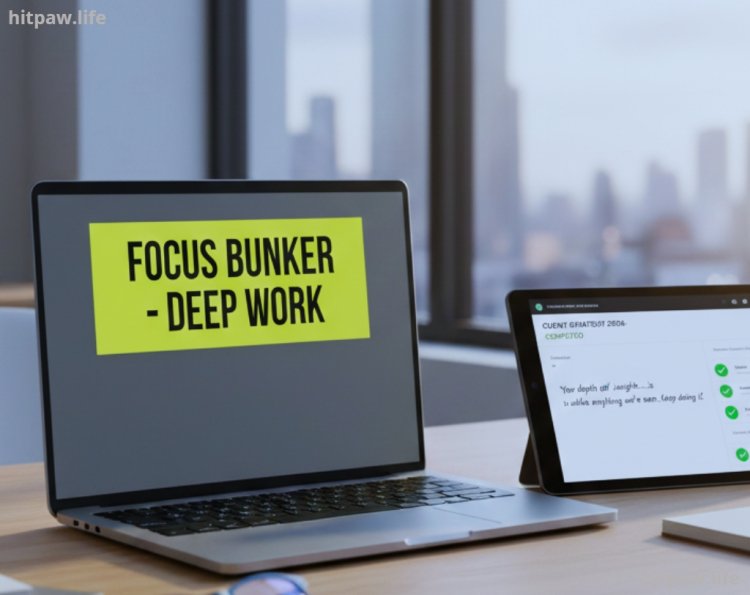
I implemented this "Focus Bunker" protocol for my latest project rebuilding a client's entire 2026 digital strategy. Here is the feedback I received from the Project Lead:
"Your depth of insight in this proposal is unlike anything we've seen from other remote contractors. It feels like you spent weeks on this, even though your logs show it only took you three days of focused work. Whatever you're doing, keep doing it."
This proved to me that Focus is a competitive advantage.
Final Advice: Build a System, Not a Wish
You don't "find" focus; you build a world where focus is the only option. Stop relying on your "willpower" it’s a finite resource that runs out by 2:00 PM. Instead, rely on your environment. Use the cool lights, the noise canceling headphones, and the "hard blocker" apps to do the heavy lifting for you.
When you make it harder to be distracted than it is to work, focus becomes your natural state. Your home is not just your house anymore; it is the cockpit of your career. Treat it with that level of engineering precision.
Frequently Asked Questions
1. Is "Opal" really better than just putting my phone on "Do Not Disturb"?
Yes. In 2026, "Do Not Disturb" is too easy to bypass. You can just tap "Ignore for 15 minutes." Opal (specifically the "Deep Focus" mode) uses a Virtual Private Network (VPN) profile to physically block the servers of distracting apps. You literally cannot get to them until the timer is up. It removes the "Decision Fatigue" of having to be disciplined.
2. What if I don't have space for a 72 inch "Wing Desk"?
The size doesn't matter as much as the Purpose. If you have a small 30 inch desk, keep it 100% clear of non work items. No mail, no snacks, no toys. The "Materials" should be minimal: a monitor, a keyboard, and a water bottle.
3. How do I deal with "Mental Fatigue" after a 3 hour deep work session?
I recommend "Non Sleep Deep Rest" (NSDR) or a 10 minute meditation. Don't look at a different screen (like your phone). Close your eyes and let your brain process the information you just handled. This "Consolidation Phase" is where the best ideas actually form.
4. I have kids/pets. How do I maintain a "Focus Bunker"?
This is where Sensory Cues for them come in. I use a "Status Light" outside my door. If the light is Red, my family knows it’s a "No Knock Zone." For pets, a consistent "Office Time" routine like giving a dog a specific chew toy only when you're at your desk helps them settle into your schedule.
5. Why "Brown Noise" instead of music with lyrics?
Lyrics activate the Language Processing part of your brain (Broca's area), which is the same part you need for writing or analyzing data. It’s like trying to have two conversations at once. Brown noise provides a steady, low frequency wall of sound that protects your language centers.
What's Your Reaction?